Have you ever encountered disputes or risks related to "short-shipment" or "short-receipt" in import/export logistics?
"Short-shipment" or "short-receipt"—where the quantity of goods actually received is less than the quantity ordered—is one of the most vexing issues in international trade.
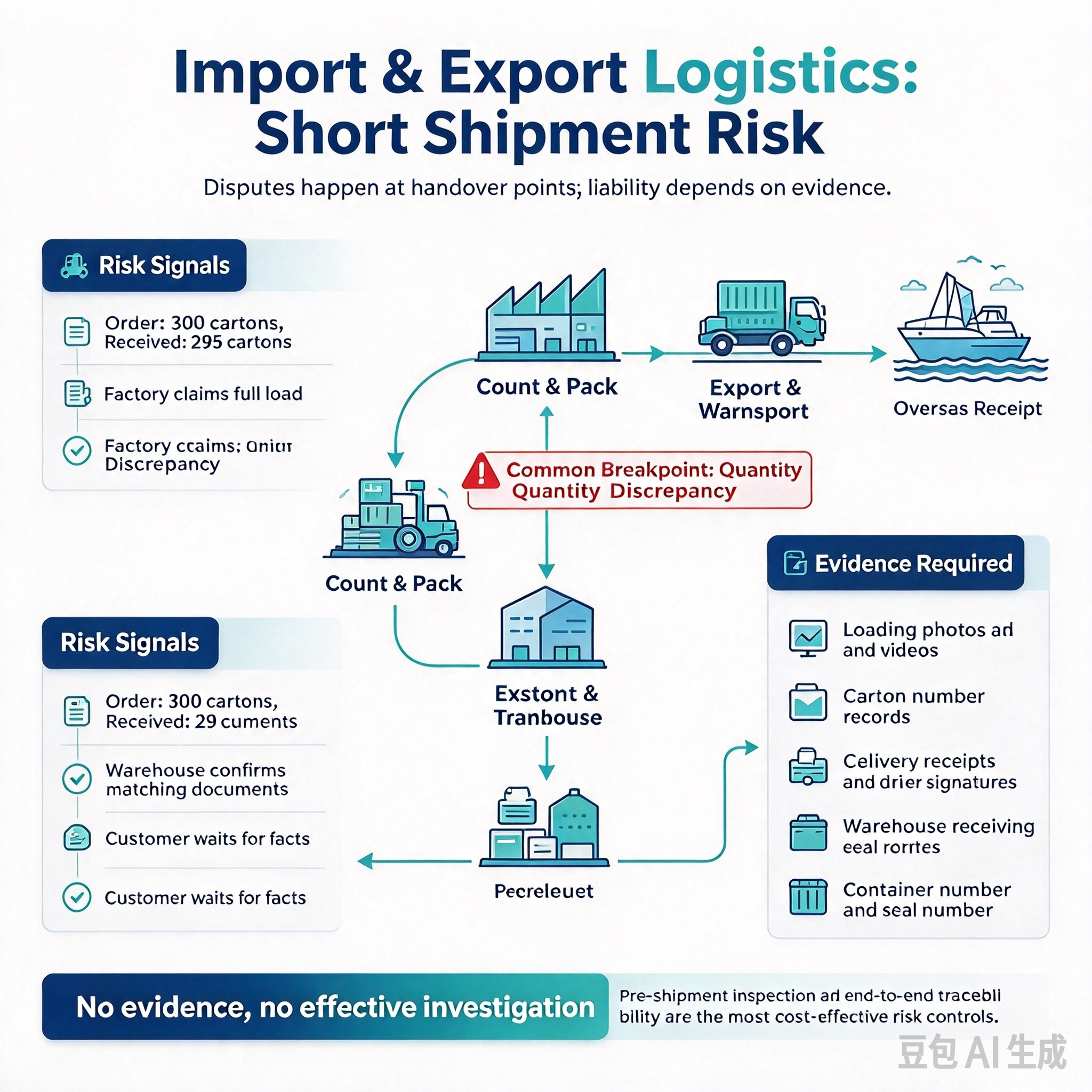
A common scenario: A client emails, "We only received 295 cartons, but the order was for 300."
Immediately, the blame game begins. The factory insists they loaded all 300 cartons; the freight forwarder and warehouse claim that what they received matches the documentation perfectly. Everyone has their own justification, yet the missing 5 cartons remain unaccounted for.
The worst possible approach is to simply relay the factory’s response—"That’s impossible"—to the client.
Clients have no interest in excuses or finger-pointing; they want facts and solutions. Passing on vague, defensive responses only erodes trust and may even lead the client to unilaterally deduct the value of the missing goods from their payment.
Do not rush to reship goods or issue compensation.
Verbal assurances are meaningless. You need concrete evidence—such as factory audit reports, pre-shipment inspection records, and a complete chain of logistics documentation—to substantiate your position.
First, implement risk control at the factory level.
• Assign someone to oversee the counting process. Document the entire loading procedure with video and photos, ensuring that carton numbers are clearly visible. Never rely solely on the factory’s own "internal verification."
Second, verify all handover documentation.
• Carefully review delivery notes, driver signatures, and warehouse receiving records. A formally signed document confirming the quantity is essential for determining where responsibility lies.
• For Less-than-Container Load (LCL) shipments, pay close attention to the warehouse receiving report. If the quantity received by the warehouse is insufficient, the issue likely occurred during transit from the factory to the warehouse. If the warehouse confirms that the received quantity is correct, then the problem must have arisen during the subsequent sorting or distribution stages handled by the freight forwarder. • For Full Container Load (FCL) shipments, always verify the container and seal numbers, and maintain a visual record (photos/videos) of the loading process. If the container seal remains intact upon arrival, you can rule out any issues occurring during the loading phase at the factory.
Remember this golden rule: without evidence, an effective investigation is impossible. While capturing and storing photos and videos may seem cumbersome, they serve as your strongest evidence to avoid liability for losses should any issues arise.
In international trade, the greatest risk is not the shortage of goods itself, but rather the inability to provide evidence to protect your interests when a problem occurs. Standardized pre-shipment inspections and end-to-end traceability remain the most cost-effective tools for risk management.
Have you ever encountered a dispute due to a shortage of goods? Who ended up bearing the loss? Share your experience in the comments section below!
#InternationalFreightForwarding #SupplyChainManagement #Sourcing # SupplierDueDiligence #SupplierAudit #QualityControl #PreShipmentInspection #CustomsClearance #LogisticsManagement #SupplyChainRiskManagement #